
The Material Whisperer Who Dances With Light
Fenna Kosfeld is a young German-born artist and material explorer who works between Germany and Barcelona, trained in Fine Arts at the University of the Arts London and later in New Materials at Elisava School of Design and Engineering in Barcelona. At 25, she's redefining how we understand sculptural lighting by creating pieces that feel more like companions than objects.
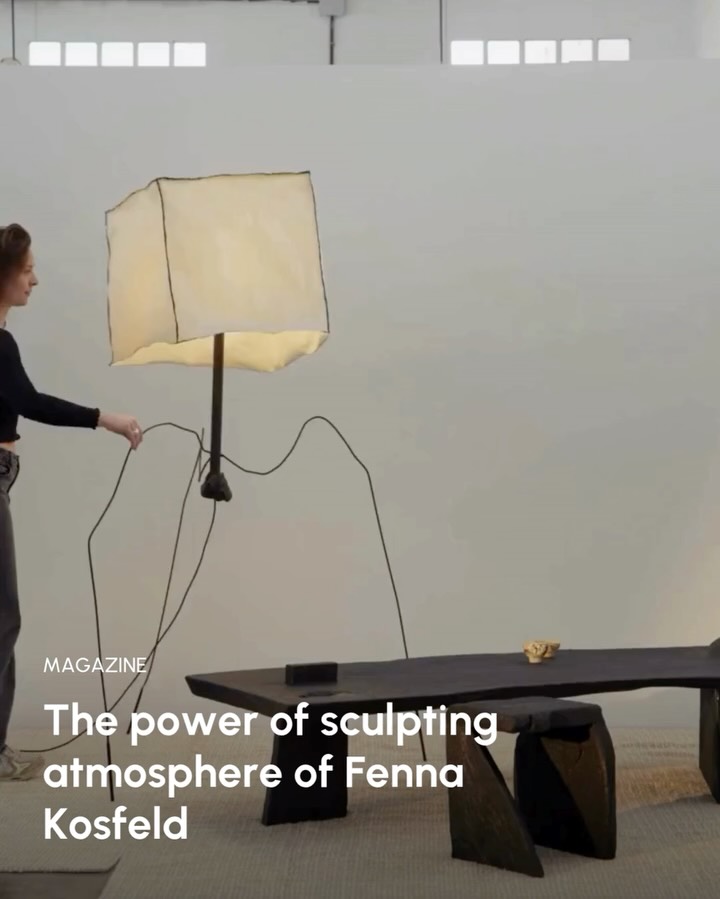
The moving series is called the Dweller family, and these aren't your typical lamps. She sees them as creatures, or, better, companions. Each piece emerges from an intimate process where she starts dancing with the sculpture in her studio, and that was how the balance and structure emerged.
From Pandemic Isolation to Sculptural Innovation
Kosfeld's breakthrough came during the 2020 pandemic lockdown. At the end of her studies, during the pandemic, she had a large but isolated studio to herself at Chelsea College. With the campus almost empty, she spent a lot of time thinking about how art and objects could coexist with everyday life.
That led to founding a garden project with her friend Marnie, called GREENHaus, in which they introduced sculpture into living ecosystems and let coexistence happen. That's where her first outdoor light sculpture really came together. It was made of birch bark and installed in an outdoor garden space, illuminated by solar panels. For the first time the narrative, the material choice, the surrounding space and light as a medium all converged.
The Science Behind the Poetry
What sets Kosfeld apart is her technical foundation. She works a lot with metal, which is her primary sculptural medium, alongside some unusual materials like bones. The bodies of the Dwellers, both the moving ones and the smaller sculptures, are made from bone – currently cow bone. This choice comes from earlier research she conducted on carbonized materials and their potential in sustainable material design.
Carbonizing organic matter creates a very porous structure. Each material forms its own kind of carbon architecture, capable of holding nutrients, water, liquids, and even absorbing smells. It behaves almost like a battery, storing and interacting with its environment.
The Barcelona Connection
Fenna Kosfeld (1999) is a German-born artist and material designer based in Barcelona. Her practice explores the emotional and atmospheric potential of light and natural materials through sculptural light objects, installations, photography, and landscape-based works.
Barcelona's design scene, anchored by institutions like Elisava School, has become a hotbed for material innovation. This campus has been listed as one of the Top 100 design schools in Europe, positioning the city as a crucial hub for experimental design education.
Movement as Medium
The pieces move, and that changes the relationship with the object. For her, this movement enables to connect with it on a very personal level. Dance also plays a role in her process – moving her own body, letting gestures and breath guide the shaping of the piece.
This kinetic approach reflects broader trends in contemporary sculpture where static forms give way to responsive environments. The Dweller family represents a new category of domestic objects that blur the line between functional lighting and living presence.
The Ritual of Transformation
During her master's research she studied the carbonization process not only from a scientific perspective but also from a ritualistic one: transforming something that was once alive through fire into a pure, dark material. The works celebrate elemental transformation and the ritualistic act of turning matter into char — a preservation of life in its most essential form, carbon.
Charred Light showcases a series of sculptural lamps crafted from carbonised wood, bones, and fired clay, paired with warm textile lampshades. The collection extends to handcrafted candles, bringing together objects of both illumination and remembrance. Each piece arises from elemental processes — charring, firing, and shaping — where fire becomes both destructive and formative.
Cultural Impact and Future Predictions
Kosfeld's work arrives at a crucial moment when consumers increasingly seek meaningful relationships with objects rather than mere functionality. It merges artistic and design practice. They can exist in a domestic space and be used, but they also evoke something more experiential.
By 2027, expect to see Kosfeld's influence ripple through the design world as major furniture brands adopt her philosophy of creating "companion objects" rather than traditional lighting fixtures. Her integration of movement, ritual, and sustainable materials positions her as a key figure in the emerging regenerative design movement that will dominate the next decade.