
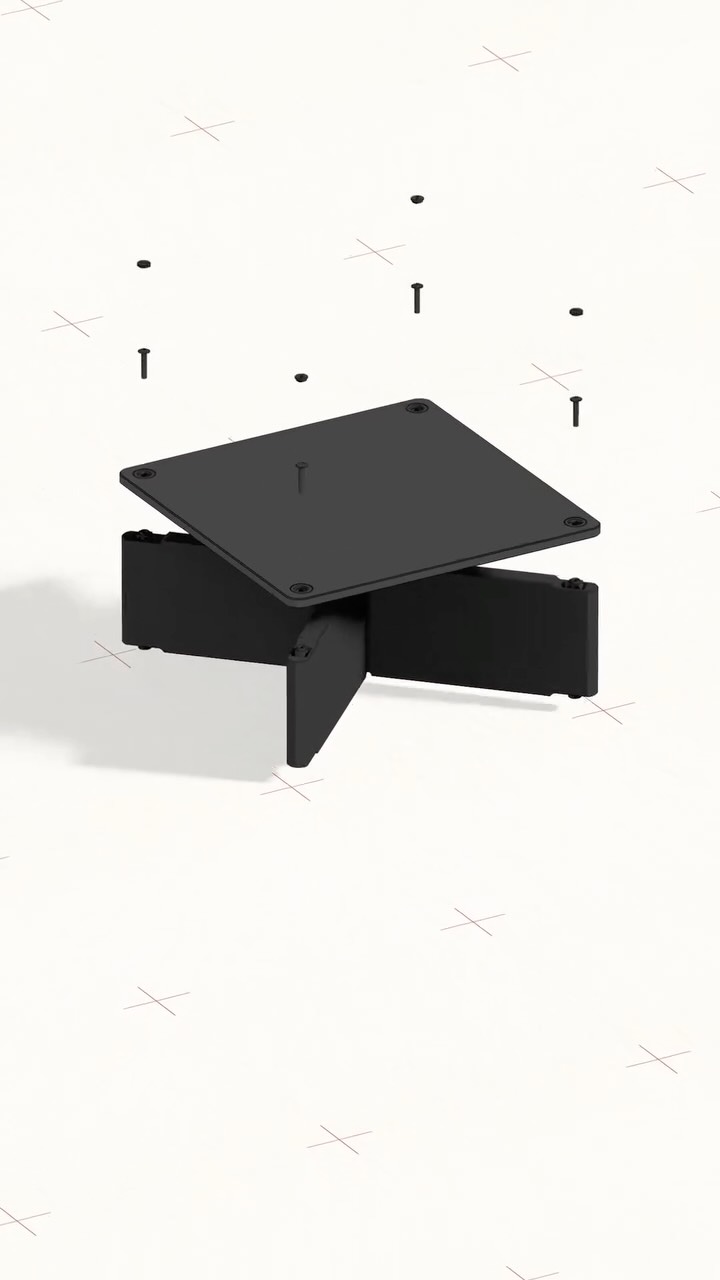
The Death of Static Office Design
Office furniture just got its biggest disruption since the cubicle died. Hürlemann designed Reset to tap the potential of the contemporary office, by allowing employees themselves to dictate the seating arrangements. The modular platform system can stack like building blocks and be set with cushions to create an endlessly customizable stepped communal space for sitting, lounging, or working. Swiss architect Stephan Hürlemann's Reset for Vitra represents the death of rigid office planning, replacing predetermined layouts with employee empowerment.
According to the latest research on workplace design, more than 70% of companies are rethinking their workspaces to make them more flexible and welcoming. The timing couldn't be better for Reset's launch as Vitra's answer to post-pandemic office anxiety.
Building Block Revolution
Reset operates on a deceptively simple premise: offices should adapt to people, not the other way around. Thanks to the modular Reset system, stepped floor structures can be assembled, remodelled, dismantled, removed and reconstructed as easily as using building blocks. The system's cross-shaped base creates triangular storage spaces while providing structural stability.
The need for self-empowerment. Employees can reconfigure the system themselves and redefine their environment. This not only creates functional added value, but also fosters a sense of ownership. The psychological impact extends beyond furniture arrangement into workplace satisfaction.
Swiss Precision Meets Human Chaos
Stephan Hürlemann brings architectural rigor to office furniture chaos. Stephan Hürlemann, born in 1972 in Herisau, Switzerland, studied architecture at ETH Zurich and subsequently worked as a partner with the designer Hannes Wettstein. After Wettstein's death in 2008, he assumed the creative direction of the Zurich-based studio, which took on his name in 2016. His 8-year collaboration with Vitra has produced game-changers including Dancing Wall.
Since 2008, more than 100 design concepts by Stephan Hürlemann have been realized – including the new headquarters Implenia Connect; the installation Giants with Dwarf for Horgenglarus; and Dancing Wall, one of Vitra's most successful products of recent years. Reset represents his most ambitious workplace intervention yet.
The Economics of Flexibility
The furniture industry faces a sustainability crisis that Reset directly addresses. The average office turns over every five to ten years, a hardly sustainable habit. Reset's modular design eliminates this wasteful cycle through infinite reconfiguration possibilities.
Reset embodies sustainable planning – durable, reusable and resource-efficient. The materials are robust and can be recycled or repurposed at the end of their life cycle – including the folding seat cushions made of V-Foam. The economic argument becomes compelling when companies calculate replacement costs.
Beyond Hybrid Work Hype
Nearly half of remote-capable employees now work in a hybrid model. While the flexibility hybrid work offers is great, it also raises challenges around connection, access to leadership, and wellbeing support. Reset addresses hybrid work's spatial challenges through instant adaptability.
Reset allows for both short-term use and longer stays because it is flexible, without requiring permanent alterations. An installation can be created spontaneously for a meeting, a presentation or a break. If a configuration proves successful, it can remain in place permanently. The system bridges temporary and permanent usage patterns.
The Psychology of Ownership
Traditional office furniture creates learned helplessness. In many work and waiting areas, furniture is static and predetermined. Reset offers the opportunity to playfully change room topographies and actively invites users to do so. Employee agency becomes a design feature rather than an afterthought.
Reset bridges the gap between rigid spatial solutions and the changing requirements of modern working and living environments. It creates spaces for encounters, retreat, education and inspiration without the need for permanently installed structures. The implications extend beyond furniture into organizational psychology.
Market Disruption Predicted
The global Commercial Office Furniture Market was valued at USD 75 billion in 2024 and is projected to reach USD 110 billion by 2033. This growth reflects a CAGR of 5.2% during 2026–2033, highlighting the sector's resilience and adaptability to changing workplace dynamics. Reset positions Vitra at the forefront of this $110 billion transformation.
The modular furniture segment will capture disproportionate growth as companies abandon fixed layouts. Companies worldwide are anticipating continued hybrid or distributed work models in 2025. A key focus is on creating "modular zones" that can be quickly rearranged as needs change. This includes movable partitions, lightweight chairs, and foldable tables that make it easy for employees to shift from individual work to teamwork in moments.
Reset isn't just furniture—it's a workplace philosophy that turns employees into space designers. Companies investing in modular systems like Reset will outperform competitors stuck with static layouts by 2026.